
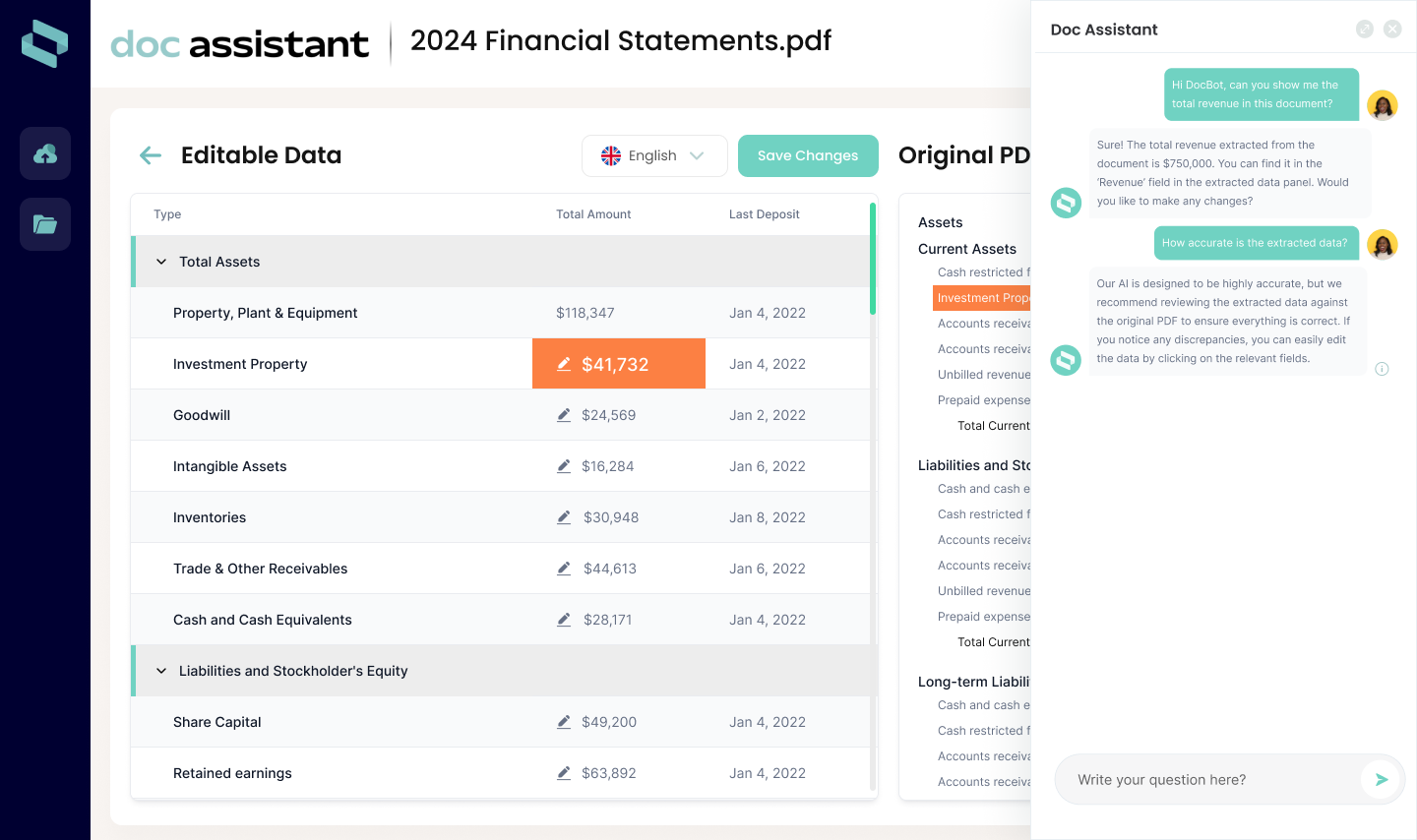
"Experts shouldn't spend their days looking for information, but using it."
Executive Summary
Lawyers, risk managers and credit analysts spend up to 70% of their time manually analyzing complex documents, according to the McKinsey Global Institute report "The Future of Work After COVID-19" (2021). This time-consuming task limits their ability to quickly produce reliable, strategic analyses.
Traditional tools have serious limitations: unreliability, inflexible rules and lack of auditability. To solve this problem, Quickscale has developed Doc Assistant, a specialized AI solution that uses advanced models (LLMs) to automate document extraction. Already tried and tested under real-life conditions in demanding contexts (banking, legal departments, ESG), Doc Assistant enables documents to be processed up to five times faster, while improving the accuracy of results.
The result? Significant time savings, reduced operational risks, and the ability to provide immediately usable data with full traceability.
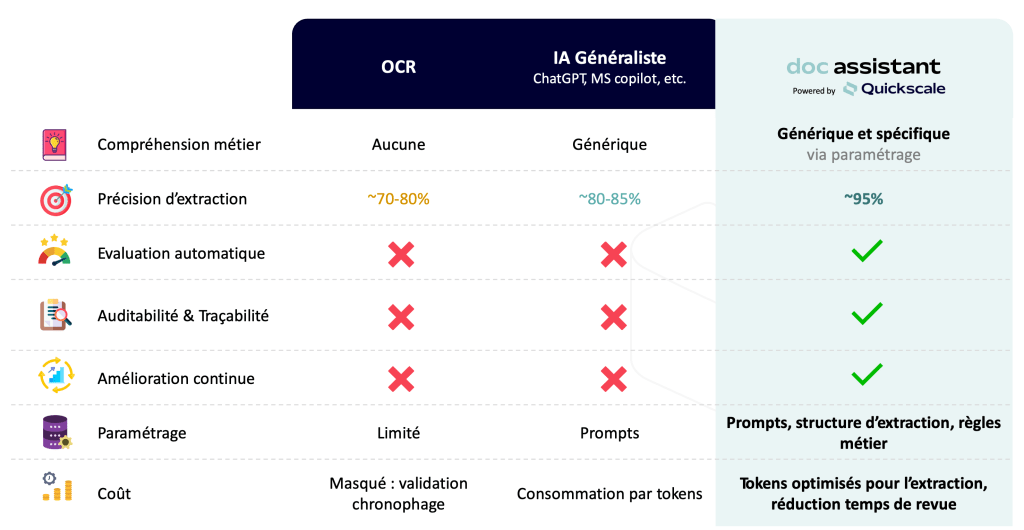
Doc Assistant enables you to increase productivity by a factor of 10, while enhancing the reliability of extracted data.
Businesses are saturated with documentation tasks
"It's not the lack of data that holds us back, but the transformation and interpretation of that data for reliable decision-making." - Credit Analyst
Business teams (legal, credit, ESG, M&A) are faced with an ever-increasing volume of critical documents. Every week, they have to go through hundreds of pages to manually extract the most important elements.
For example, lawyers analyze supplier contracts for specific clauses (liabilities, commitments), credit analysts extract financial ratios from PDF balance sheets to assess corporate solvency, ESG managers manually process CSR indicators from complex reports, and M&A analysts structure data from multiple documents as part of due diligence.
These repetitive, low-value-added tasks take up a large part of the experts' time, and generate a high risk of error.
Strategic use cases
Financial Sector
The financial sector is particularly sensitive to the need for rapid, reliable documentary analysis, especially during M&A due diligence or corporate credit origination.
- M&A & Financing due diligence: Teams need to quickly identify key risks and commitments in an often complex and multi-sourced context.
- Corporate credit origination: Manual processing of customer files slows down analyses and increases the risk of errors in financial assessments.
- Financial analysis and credit spreading: Manual extraction of key financial data is time-consuming and error-prone, considerably slowing down credit decisions.
Départements Juridique et Conformité
Les directions juridiques, tout comme la conformité, doivent gérer une quantité importante de documents contractuels où chaque erreur peut avoir des conséquences critiques.
- Contractual legal review: Manual identification of critical clauses, often without standardization or effective automation.
- ESG & regulatory reporting : ESG reporting requires accurate and consistent extraction of KPIs from unstructured documents.
- ESG KPI extraction: tedious manual processing of regulatory reports, increasing the risk of omissions or inconsistencies.
Why are conventional solutions reaching their limits?
Traditional solutions, such as simple OCR or rigid EDMs, offer neither the necessary business contextualization nor the auditability required in regulated environments. Generalist AI tools often produce imprecise or inaccurate results, leading to widespread mistrust among business users.
How Doc Assistant solves these problems in concrete terms
Doc Assistant is specifically designed to meet the demands of document-intensive professions:
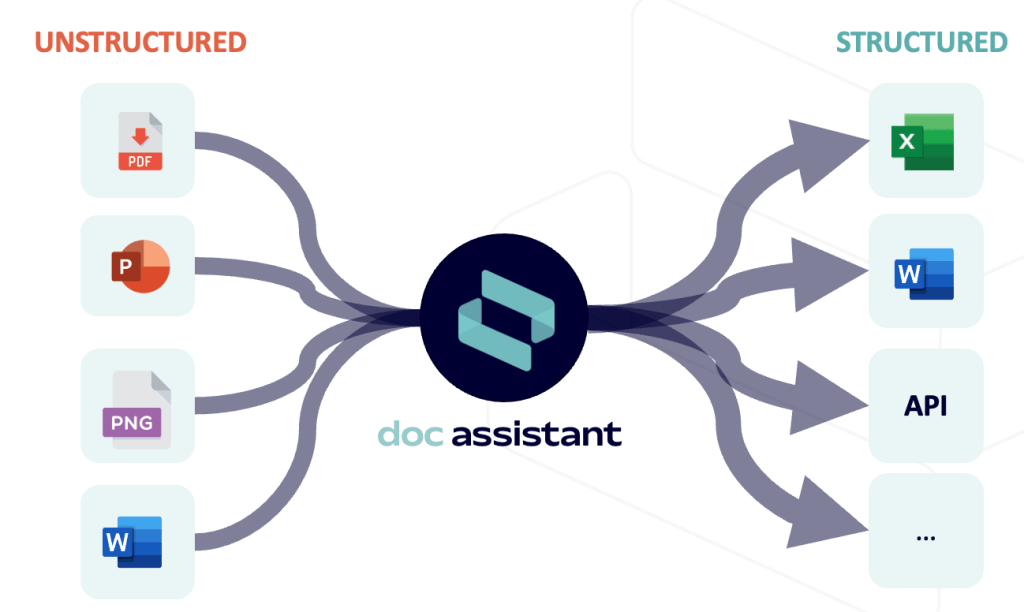
- Contextual reading: Precise understanding of the business specificities of documents.
- Structured extraction: Data retrieval in automatically validated formats.
- Synthesis & reporting: Production of immediately usable summaries.
- Native auditability: every piece of data extracted is traceable and justifiable.
Case in point: Reviewing commercial leases
As part of a business law firm's activity, Doc Assistant was used to automate the review of complex commercial leases for the production of summary sheets. Each lease required the extraction of 170 data points (duration, rents, charges, exit clauses, suspensive conditions, etc.) and the drafting of a summary sheet readable by the transactional teams.

- Avant Doc Assistant: 2 hours of careful reading per lease, with manual compilation in Excel and line-by-line legal validation.
- After Doc Assistant: Automatic extraction of 170 fields in less than 2 minutes, generation of a structured template for the analysis form, human review reduced to 15 minutes.
This automation has increased team productivity by a factor of 8, while securing critical points: traceability of each extracted field and audit capability.
When should you choose Doc Assistant?
Doc Assistant is ideal for teams who regularly process unstructured documents (e.g. contracts, reports, balance sheets), and who want to speed up and industrialize their document extraction processes. On the other hand, if the documents to be processed are essentially visual or one-off, Doc Assistant is not suitable.
See for yourself!
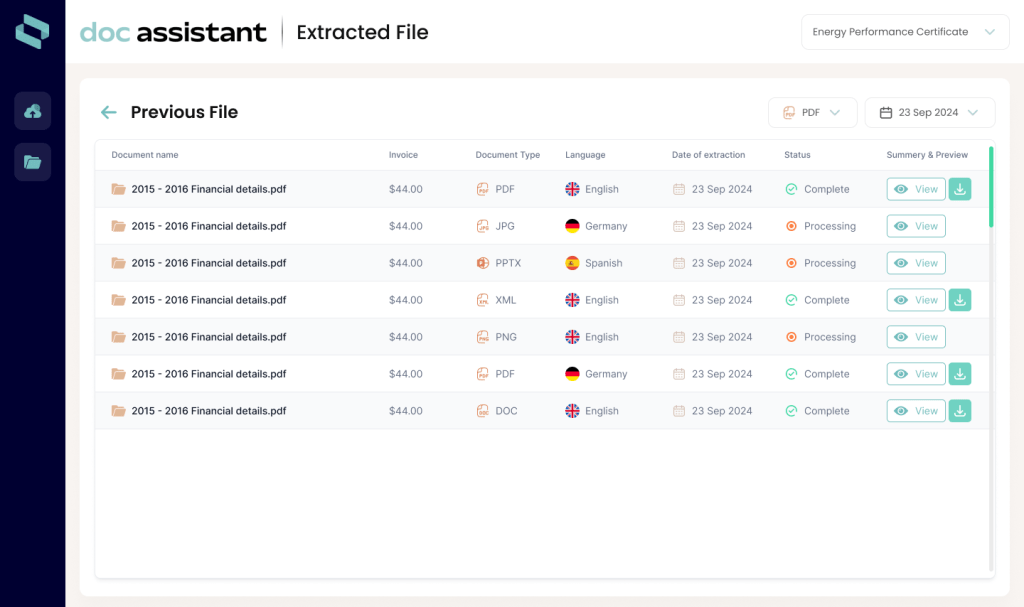
To discover the concrete benefits of Doc Assistant on your process, book an appointment. In just 30 minutes, we can define a concrete test tailored to your needs.


